
Introduction
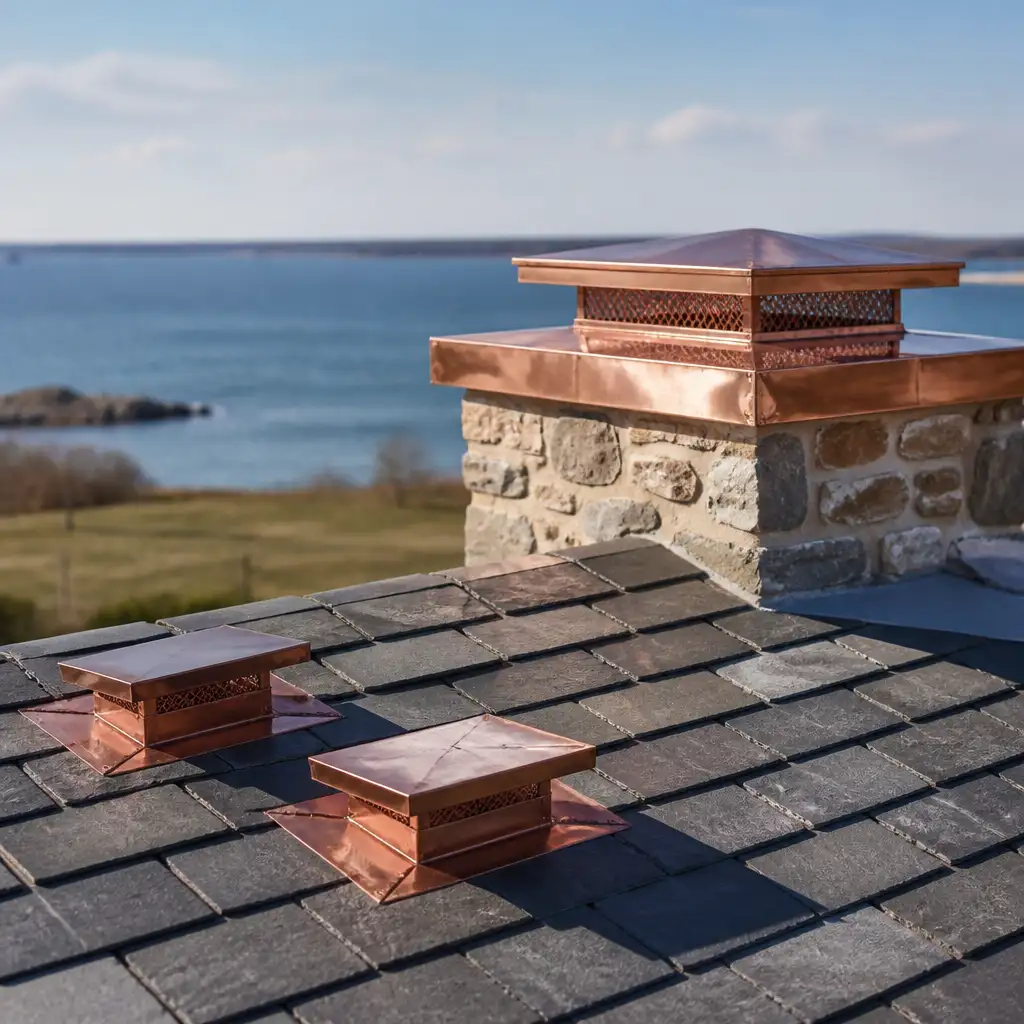
For roofing contractors and architects working in Massachusetts and New England coastal zones, properly specified copper chimney caps and roof vents are vital to long-term performance. This article focuses on low-profile cap designs, ventilation sizing, bird and spark protection, and material and finish strategies to resist salt-air exposure on Cape Cod. The guidance is specification-focused and intended for trade professionals—roofing contractors, architectural metal fabricators, restoration specialists, and design teams.
Low-profile copper chimney caps must balance aerodynamic performance, unobtrusive appearance, and durability. On the Cape and broader Coastal Massachusetts, salt spray accelerates corrosion of dissimilar metals and degrades non-metallic coatings. That means material selection, seam detailing, and fastening strategies must be planned from design through installation.
This article includes fabrication tolerances, recommended fastening approaches, and maintenance intervals tailored to New England coastal conditions. It also provides practical details for specifying bird guards, spark arrestors, and ventilation free area so caps and vents meet functional and regulatory needs without adding unnecessary bulk to rooflines.
Cape Cod Copper is a trade-only architectural fabricator with experience producing custom chimney caps, vents, and copper roof components for contractors across Southeastern Massachusetts and New England. For related components reference our copper chimney caps product category early in project specification to align design intent with fabrication capabilities.
- Introduction
- Low-profile cap design principles for coastal roofs
- Ventilation requirements and sizing for roof vents and chimney caps
- Bird guards, spark arrestors, and code considerations
- Material selection and finishes to resist salt-air corrosion
- Fabrication tolerances, seams, and fastening strategies
- Installation best practices and maintenance intervals for Cape Cod conditions
- Frequently Asked Questions
Low-profile cap design principles for coastal roofs
Low-profile chimney caps are typically specified to minimize visual impact and wind loading while maintaining adequate draft and protection. For Cape Cod projects, specify caps with a minimal vertical profile—commonly 1.5″ to 3″ clear height above the flue termination—while ensuring open flow paths and room for bird and spark protection elements.
Designs should avoid wide, flat overhangs that trap moisture or collect salt and debris. Instead, use modestly tapered skirts and drip edges to shed water away from the masonry crown and surrounding flashings. Detail the cap to integrate with existing chimney flashing and roof transitions—coordinate with the building’s copper flashing package to avoid galvanic issues.
When specifying low-profile caps for historic or architecturally sensitive roofs, provide measured drawings or field dimensions. Cape Cod Copper fabricates one-off and production caps from measured drawings; early coordination reduces field modifications during installation. Consider the visual relationship to standing seam panels or other roof details produced by the fabricator to ensure consistent material and finish appearance across roof elements.
Ventilation requirements and sizing for roof vents and chimney caps
Ventilation considerations differ depending on whether the cap terminates a masonry chimney, a lined flue, or a roof-vented mechanical exhaust. For chimney terminations, match the cap opening and free area to the flue cross-section. The cap must provide an unobstructed path for combustion products while preventing downdrafts—designers commonly leave an unobstructed net free area equal to or greater than the flue area where practical.
For roof vents serving attic ventilation or continuous mechanical exhaust, use manufacturer guidelines and project ventilation calculations to determine required net free area (NFA). When in doubt, oversize the cap openings rather than restrict them—low-profile copper vents can be designed with multiple discrete, screened openings to maintain appearance while meeting NFA targets.
Include a note in specifications requiring that caps and vents not reduce listed appliance termination clearances. For mechanical appliances and fuel-burning equipment, reference appliance manufacturer and local code requirements during design development. Provide templated mounting details so the fabricator can confirm clearance and fastening needs for the finished unit.
Bird guards, spark arrestors, and code considerations
Bird intrusion and ember control are common reasons to add screens and spark arrestors to chimney caps, but these elements can impede draft if improperly sized. For coastal New England installations, specify corrosion-resistant mesh—316 stainless steel is the industry standard for salt-air environments—sized to balance protection and airflow. Typical mesh sizes used for bird exclusion are 1/2″ to 3/4″; for spark arrestors, 1/2″ stainless mesh is commonly specified, but verify appliance requirements.
Design the mesh as a removable cartridge or a separately removable insert where possible. That allows cleanings and replacements without disassembling the cap. Specify a stainless steel attachment detail—tabs, captive screws, or hinged doors with tamper-resistant fasteners—to facilitate service by trained technicians and to meet preservation goals on historic buildings.
Document code and appliance considerations in the project specifications. For wood-burning appliances or municipal projects, confirm whether a fine mesh is required by local code or by the appliance listing. When designing custom spark arrestors, include a performance note to ensure the NFA after screening meets the ventilation intent.
Material selection and finishes to resist salt-air corrosion
Choosing the right copper gauge and complementary materials is essential on Cape Cod. Cape Cod Copper routinely fabricates caps and vents in 16 oz (0.021″), 20 oz (0.026″), and 24 oz (0.032″) copper depending on project demands. Heavier gauges provide greater stiffness and resistance to wind uplift for exposed terminations.
For fasteners, mesh, and internal components specify 316 stainless steel. Use lead-coated copper for applications where extra corrosion resistance at flashings and abutments is desired; lead-coated copper combines the formability of copper with enhanced protection at immediate contact points. Avoid aluminum or standard 304 stainless in direct contact with copper in salt-air situations, and prevent contact between dissimilar metals without appropriate insulating barriers.
Architects sometimes ask about protective lacquers or pre-patinated finishes. Lacquers can delay patination and reduce early staining of adjacent substrates but will degrade under constant salt exposure and require maintenance. For long-term performance with minimal intervention, consider natural copper that develops a patina, paired with robust detailing and stainless components to manage salt-related deterioration.
Fabrication tolerances, seams, and fastening strategies
Specify fabrication tolerances and seam types to avoid costly field adjustments. Typical tolerances for shop-fabricated chimney caps and small vents are +/- 1/16″ for critical mating surfaces and +/- 1/8″ for overall dimensions on larger assemblies. Request shop drawings for complex or historic reproductions so dimensional fits with masonry crowns and flashings are confirmed before fabrication.
Seaming strategies should prioritize mechanically sound, serviceable joints. Soldered seams—hard or soft solder as appropriate—provide long-term watertightness for cap bodies and drip details. Hemmed edges reduce sharpness and increase stiffness; folded and soldered corners resist separation in windy coastal conditions. Specify continuous seams where leakage risk is high and allow for expansion gaps where thermal movement could impart stress.
Fastening to masonry and roof substrates in salt-air environments requires stainless anchors and insulating washers. For masonry chimneys, use stainless steel expansion anchors or masonry screws with stainless shims and neoprene washers where penetration is necessary. For wood or metal stacks, specify stainless fasteners with backing plates or clamps distributed to limit stress concentrations—typical screw spacing for thin-gauge copper to support plates is 6″ to 8″ on center unless a heavier backing is provided.
Installation best practices and maintenance intervals for Cape Cod conditions
Installation details directly affect longevity. Ensure the cap integrates with the chimney crown and flashing system so that water is directed away from mortar joints and roof deck interfaces. Coordinate cap mounting with the roofing panels and flashings package when copper is used across multiple roof elements to avoid differential movement or staining of adjacent materials.
Fastener selection and penetration methods should be documented in the installation drawing set. Use captive stainless fasteners with neoprene washers where the fastener head is exposed to seal and isolate the copper surface. For installations requiring mechanical anchors into masonry, include notes requiring stainless sleeves and a non-conductive gasket to avoid galvanic corrosion at metal-to-masonry contact points.
Recommended maintenance intervals for coastal chimney caps and vents: visual inspections at 6-month intervals (spring and fall) to check mesh integrity, fastener security, and evidence of salt staining; light cleaning and debris removal annually; and a thorough service—re-soldering, mesh replacement, and anchor re-torque—every 3–5 years depending on exposure. Document these intervals in the project O&M and include access instructions for service technicians.
Frequently Asked Questions
Q: What copper gauge do you recommend for low-profile chimney caps in a salt-air environment?
A: For Cape Cod conditions we commonly recommend 20 oz or 24 oz copper for exposed chimney caps and vents. Heavier gauges increase stiffness and resistance to wind and handling during service. Use 16 oz only for sheltered or decorative elements where structural demands are lower.
Q: What mesh type and size should be specified for bird exclusion and spark arresting?
A: Specify 316 stainless steel mesh. For bird exclusion, 1/2″ to 3/4″ mesh is typical; for spark arresting, many projects use 1/2″ mesh but confirm appliance and local code requirements. Design the mesh as a removable cartridge for serviceability.
Q: How tight should fabrication tolerances be for custom caps that mate to an existing masonry crown?
A: Request shop drawings and provide field-measured dimensions. Standard shop tolerances are +/- 1/16″ on critical mating surfaces and +/- 1/8″ on larger assemblies. For historic restoration or tight fits, tighter tolerances and a mock-up may be necessary; include measured drawings and photographs with your RFQ to avoid rework.
Working from drawings, field measurements, or a custom detail? Cape Cod Copper partners with trade professionals to fabricate copper components made to fit the job, from custom flashings and roof panels to leader heads, chimney caps, vents, and decorative architectural details. Call (508) 946-1999 or email capecodcopper2@gmail.com to review your project requirements.